
ELECTRONIC & ENGINEERING CO. (I) P. LTD.
01
Jun
Share
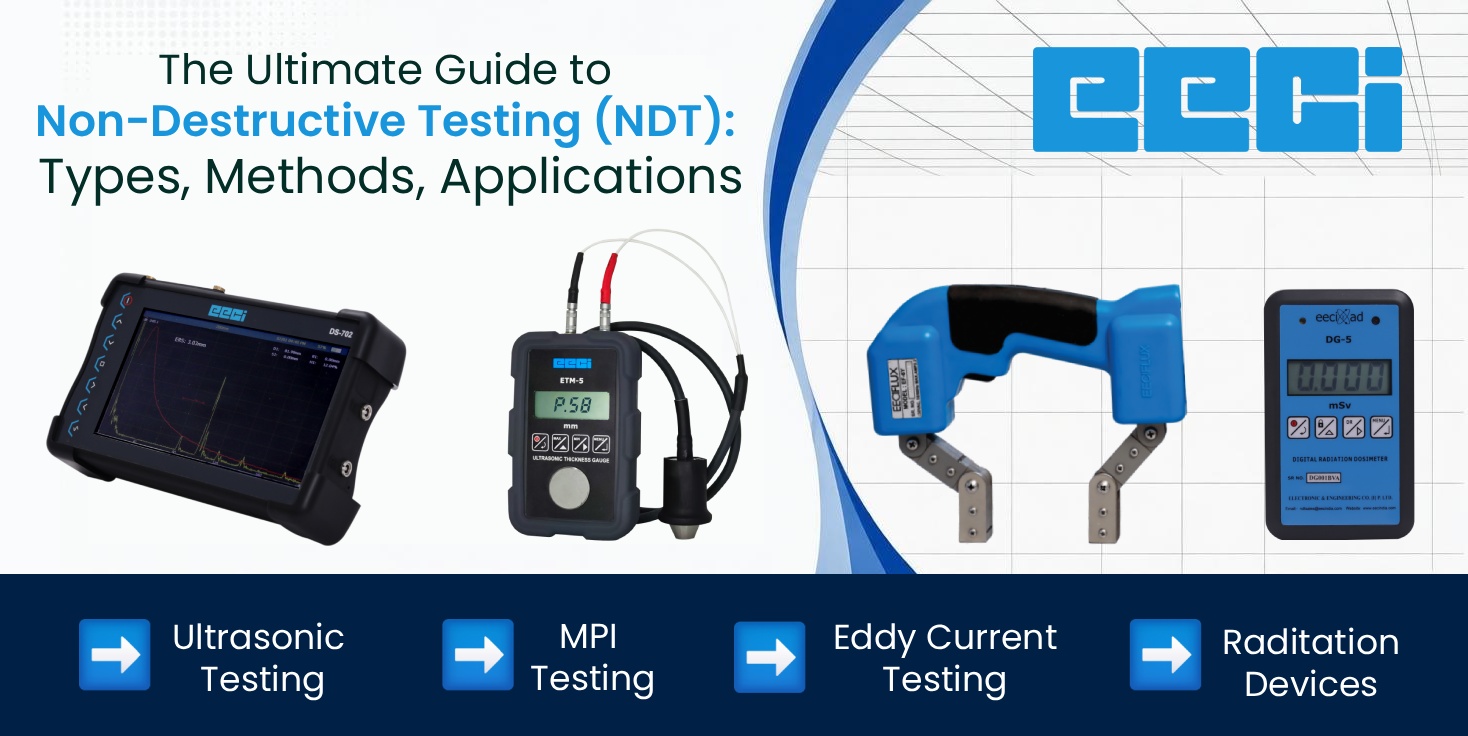
No Comments on The Ultimate Guide to Non-Destructive Testing (NDT): Types, Methods, Applications EECI Blogs
The Ultimate Guide to Non-Destructive Testing (NDT): Types, Methods, Applications
What is Non-Destructive Testing?
Non-destructive testing is a set of techniques that is widely used to evaluate the properties, quality of materials, components or structures without causing any damage or wear & tear of any part keeping it in usable condition unlike destructive testing.
Non-destructive testing is commonly acknowledged as NDT in industries, technical sectors.
NDT inspection and testing play a crucial and vital role in wide sectors of industries like oil & gas, aerospace, railway, manufacturing, construction, power generation, nuclear power plants, and many other sectors. It is trusted advanced technology which provides operations along with safety.
NDT testing is the best solution if one wants to detect flaws, cracks, tiny defects, or inconsistencies in any material without damaging or breaking it.
For different sectors of industries, NDT provides versatile range of devices depending upon its application that ensures the result which leads to the accuracy and desired output with minimal requirements. Equipment failures can be avoided with the help of NDT Testing methods.
Let’s get more well versed with this technology in detail to understand its benefits and advantages over old school methods of technology.
GET IN TOUCH
Have an NDT Requirement ?
Get technical guidance • Product recommendations • Customized solutions
Why is NDT Important in Industries?
- By ensuring Product Quality: In any of the manufacturing industries quality stands first. In order to reduce defects and flaws, to gain trust of customers on products. NDT helps to check that product meets standards before shipping to customers.
- Safety assurance: NDT is renowned for identifying hidden defects even before they turn into serious failure or damages. In industries like oil & gas, aerospace even a small crack can lead to serious damage to infrastructure and sometimes it might be fatal also. By detecting these or flaws early NDT helps in saving both human life and infrastructure.
- To meet industry standards: To keep things safe and top-notch quality, industries have to meet the standards of API and ASME systems. For this NDT provides accurate and precise solutions along with safety.
- For making maintenance smarter & avoiding sudden Breakdowns: Proper maintenance always helps to save damages caused out of breakdown. This makes planning easier and operations smooth running. NDT helps to predict when and why maintenance is required.
- To enhance the life of equipment: Regular inspection of equipment leads to early detection of problems which have occurred or may occur so with this we can fix it on time even before damage is caused without leaving a scratch on it. NDT further helps to save time and expense on repairing parts.
Do You Require Advanced NDT Equipment ?
Discover EECI’s leading NDT Industry Solution for oil & gas, aerospace, manufacturing, welding inspection, and more.
Difference of advantages of NDT over Destructive techniques:
Destructive technique is an old method of testing by breaking something to check how strong or prominent it is in reality whereas Non-destructive technique is used to check flaws and defects at primary stages only without causing any damage or harm to that object. Both techniques are important in their way in different situations and applications. Let’s understand in detail.
- Material condition
Destructive: It is damaged, broken, or permanently deformed.
Non-destructive: It remains intact and usable after testing.
- Purpose
Destructive: Determining strength, limits and failure point of material.
Non-Destructive: Detecting defects and ensuring safety without damage.
- Usage
Destructive: During design research, and initial quality.
Non-destructive: During manufacturing, quality checking, while servicing.
- Types of Result
Destructive: Shows exact values like strength, toughness and breaking points, destructive analytical approach.
Non-destructive: Detect defects like crack, corrosion, internal flaws, preventive diagnostic approach.
- Safety Role
Destructive: Helps to understand limits before use.
Non-destructive: Ensures safety reliability.
- Cost Impact
Destructive: Higher due to destruction of objects.
Non-Destructive: Cost effective in the long run as no material is damaged.
What are the different types of NDT methods & its Application ?
Non-Destructive Technique is widely used all over industrial sectors on great scale. Its advantages over old technical methods make it easily adaptive as for every different industry NDT is offering different instruments, devices, systems and many other things.
NDT ensures accurate reliability, safety, cost effective, user friendly, easy to carry on job sites, gives output without stopping any operation or can be repaired also, meet industrial standards with API & ASME, other requires certifications and many more advantages makes it most adaptable technique.
EECI offers a wide range of equipment with advanced latest technology which also meets customised needs of customers and industries.
Let’s have a detailed look and understand these types of NDT methods, its benefits along with applications in different industrial sectors.
Types of Non-Destructive Testing Methods
Ultrasonic Testing (UT):
Ultrasonic testing uses high frequency sound waves to detect internal flaws or measure thickness. Its work principle is based upon transmitting sound waves into the material.
Advantages- High accuracy, deep penetration, detecting internal defects.
Application -Weld inspection, thickness measurement, crack detection.
Radiographic Testing (RT):
Radiographic testing uses X-rays or Gamma rays to capture images of internal structures. Its work principle is passing radiation through the material. A detector captures images showing defects.
Advantages – Permanent visual record, detailed internal view.
Application- Pipeline inspection, casting inspection, aerospace components
Magnetic Particle Testing (MPI):
Magnetic particle testing is used for detecting surface and near surface defects in ferromagnetic materials. It works on the principle of applying magnetic field, gathers magnetic particles at defect location.
Advantages – Simple and quick, cost effective.
Application – Crack detection in steel, weld inspection.
Liquid penetrating Testing (LPT):
Liquid Penetrant Testing detects surface defects using a liquid dye. It works on the principle of applying liquid penetrant which seeps into the crack. Developer reveals cracks.
Advantages- Easy to use, works on non-porous material.
Application – Surface crack detection, aircraft component.
Eddy Current Testing (ECT):
Eddy current testing uses electromagnetic induction to detect flaws. It works on the principle of that electric current creates magnetic fields, and changes indicate defects.
Advantages- No contact required, fast inspection.
Application- Heat exchanger tubes, aircraft inspection.
Visual Testing (VT):
Visual Testing is the simplest method involving direct observation. It works on the principle of visually examining the surfaces with help of the tools.
Advantages- cost effective, instant results. Application- Surface defects, initial inspection.
Phased Array Ultrasonic Testing (PAUT):
It is an advanced version of ultrasonic testing using multiple probes.
Advantage- high precision.
Application-Real time imaging.
Time of Flight Diffraction (TOFD):
It measures the time taken for diffracted sound waves.
Advantage: Accurate crack sizing.
Application: Reliable result.
Versatile Application of NDT in Different Industries
NDT is widely used in various industries depending upon the requirement of its application. Like we earlier discussed, its key methods. NDT applications in industries, for example, NDT in aerospace industry, NDT in power plants, NDT in construction, NDT in manufacturing, NDT in pipelines, NDT inspection for welding and more. Let’s understand its area of application.
- Oil & Gas Industries: Pipeline inspection, leak detection, corrosion monitoring.
- Aerospace Industries: Aircraft component testing, structural integrity checks.
- Manufacturing Industries: Defect detection, quality control.
- Construction Industries: Building inspection, Structural safety.
- Power Plants: Boiler inspection, Turbine Testing.
Which NDT method is best for weld inspection ?
NDT methods applicable for welding inspection depending upon the requirement, NDT methods are applied in welding.
- UT (Ultrasonic Testing): Best applicable in Internal Defects.
- RT (Radiographic Testing): Best for imaging.
- MPI (Magnetic Particle Testing) & LPT: Best in detecting surface cracks.
Looking for Reliable NDT Inspection Solutions?
Industries all over the world rely on EECI’s superior Ultrasonic Testing, Radiographic Testing, Magnetic Particle Testing, Eddy Current Testing and customized NDT equipment.
Key NDT Certification Bodies & Standards
- American Society of Non-Destructive Testing (ASNT): Globally most recognised NDT organization. Personal qualification provides ASNT Certification (nofollow external link) Level I, II, III and guidelines like SNT-TC-1A.
- ISO 9712: An international standard for NDT Personnel certification. Ensures technicians are qualified and certified through independent third -party.
- British Institute of Non- Destructive Testing (PCN): This BINDT certification is widely accepted in oil & gas, aerospace. It’s focused on competence-based certification aligned with ISO certification.
- American Society of Mechanical Engineers (ASME Codes): Provides codes for inspection of pressure vessels, boilers and piping. NDT methods are mandatory under ASME section V.
- American Petroleum Institute (API standard): Prominently used in oil & gas industries. Define inspection and NDT requirements for pipelines, tanks and refineries.
- International Organization for standardisation (ISO Standards): Provides overall frameworks like ISO 9001(quality)and supports NDT practices globally ensures consistency and quality in inspection processes.
- European committee for Standardization (EN standard): Develops European NDT standards (EN ISO) common in aerospace, railways and infrastructure sectors.
- Bureau of Indian Standards (India):Defines Indian standards for NDT practices. Aligns with global standards for local compliance.
- National Accreditation Board of Certification Bodies: Accredits Certification bodies that certify NDT personnel and systems in India. Ensures credibility of certifications.
How to Start a Career in NDT ?
NDT Testing for Beginners
Anyone new to NDT can begin with this career by following the steps
- Step 1– Learn and understand the basics of differentNDT methods and Principles.
- Step 2 –Choose a method in which you want to acquire specialization like UT, RT, MPI or any other.
- Step 3- Get certified into that method by enrolling into certified training programs, you can also join our free NDT training/certification program.
- Step 4 – Work under experienced inspectors to gain experience.
NDT Certification Requirement
Certification is essential work as an NDT professional.
- Level 1: Basic Testing under supervision.
- Level 2: Independent Inspection and Interpretation.
- Level 3: Expert level, training and interpretation.
Key Certification Body
ASNT Certification (American Society for Non-destructive Testing)
NDT Jobs and Career Opportunities
With high demand of NDT in Industries worldwide.
Job Roles in this sector–
- NDT Technician
- NDT Inspector
- Quality Control Engineer
- Welding Inspector
Industries Hiring-
- Oil &Gas
- Aerospace
- Manufacturing
- Construction
Why Choose EECI for NDT Equipment?
About EECI
EECI is testing the pioneer in the field of Ultrasonic Non-Destructive Testing (NDT) with over 50 60 yrs of proven expertise since 1958. EECI is prominently recognized as India’s leading manufacturer of NDT equipment. Our strength lies not only in our experience but also in solid foundation of a Government of India-Approved R&D department, state of the art manufacturing facilities and a strong nationwide presence through nine regional sales offices and service centres EECI product range extends from compact portable devices to large customized solutions, covering ultrasonic, magnetic particle, Radiography, Eddy current technologies and more.
EECI also partners with globally renowned manufacturers further expanding the solutions.
EECI Believe in
- Focusing on customers and providing ideal solution for application.
- Continual innovation to produce cutting edge products.
- Creating a long-lasting partnership with our customer.
- Maintaining a high threshold for the quality and performance of solutions for uninterrupted operations.
EECI has successfully supplied innovative solutions to important industries such as
- Steel
- Aerospace
- Automotive
- Railway
- Defence
- Oil & Gas
- Nuclear
- Heavy Engineering Industry
- NDT service Providers
- Renowned Educational Institutes
In addition to India, EECI has developed and partnered with a large clientele in Americas, Asia, Europe & Africa.
Conclusion
Non- Destructive Testing (NDT) is an essential tool and powerful in modern day technology in industries. It ensures safety improves quality and reduces cost by reducing defect damaging materials.
From Basic to latest advanced technologies are continually evolving and expanding all across the industries.
If you are looking for a field that combines technology, safety and real-world impact, NDT is a great choice with proper training, certification, and can build a successful career as an NDT professional in India or abroad.
With 60 years of proven expertise India’s leading manufacturer of NDT equipment since 1958
UT (Ultrasonic Testing) , RT (Radiographic Testing) , MPI (Magnetic Particle Testing) , ET (Eddy Current Testing) & more PAN India Service Support Request Custom Quote or Expert Assistance
Frequently Asked Questions (FAQs) on Non-Destructive Testing (NDT)
1. What is Non-Destructive Testing (NDT)?
Non-Destructive Testing (NDT) is a testing and inspection method used to evaluate materials, components, or structures without damaging them. It helps detect defects, cracks, corrosion, and internal flaws while keeping the object fully usable.
2. Why is NDT important in industries?
NDT is important because it ensures product quality, improves safety, prevents equipment failure, reduces maintenance costs, and helps industries comply with international safety standards like ASME, API, and ISO.
3. What are the most common NDT testing methods?
The most widely used NDT methods include:
- Ultrasonic Testing (UT)
- Radiographic Testing (RT)
- Magnetic Particle Testing (MPI)
- Liquid Penetrant Testing (LPT)
- Eddy Current Testing (ECT)
- Visual Testing (VT)
- Phased Array Ultrasonic Testing (PAUT)
- Time of Flight Diffraction (TOFD)
4. Which NDT method is best for weld inspection?
Different NDT methods are used for weld inspection depending on the requirement:
- UT for internal defect detection
- RT for detailed weld imaging
- MPI and LPT for surface crack detection
5. What industries use NDT inspection and testing?
NDT is widely used in industries such as:
- Oil & Gas
- Aerospace
- Manufacturing
- Construction
- Railways
- Power Plants
- Automotive
- Nuclear Industry
6. What is the difference between destructive and non-destructive testing?
Destructive testing damages or breaks the material to determine its strength and failure point, while non-destructive testing checks for defects without causing any damage, allowing the material to remain in service.
7. What are the advantages of NDT?
Major advantages of NDT include:
- No damage to components
- Early defect detection
- Improved safety and reliability
- Reduced maintenance costs
- Increased equipment life
- Compliance with industry standards
8. What certifications are required for an NDT career?
Popular NDT certifications include:
- ASNT Level I, II, and III
- ISO 9712 Certification
- PCN Certification
- API and ASME-based qualifications
These certifications validate the skills and competency of NDT professionals.
9. Is NDT a good career option?
Yes, NDT is a highly demanding career with opportunities in India and abroad. Industries continuously require skilled NDT technicians, inspectors, and quality control professionals for inspection and maintenance work.
10. How do beginners start a career in NDT?
Beginners can start by:
- Learning NDT basics and methods
- Choosing a specialization like UT, RT, or MPI
- Completing certified NDT training
- Gaining practical field experience under qualified inspectors
- Obtaining ASNT or ISO-recognized certification
