
ELECTRONIC & ENGINEERING CO. (I) P. LTD.
31
Aug
Share
No Comments on NDT Vs Destructive Testing – Which is Right for your manufacturing process EECI Blogs
NDT Vs Destructive Testing – Which is Right for your manufacturing process
In manufacturing industries, ensuring that every component meets the required quality and performance standards is equally important as producing it efficiently. A component may look perfect on the outside yet internal defects, material inconsistencies or process variation can affect its performance and service life. This is where material testing, NDT inspection and quality control in manufacturing become an essential part of the manufacturing process. Understanding the NDT vs Destructive Testing Process can help manufacturers choose the right testing and inspection approach.
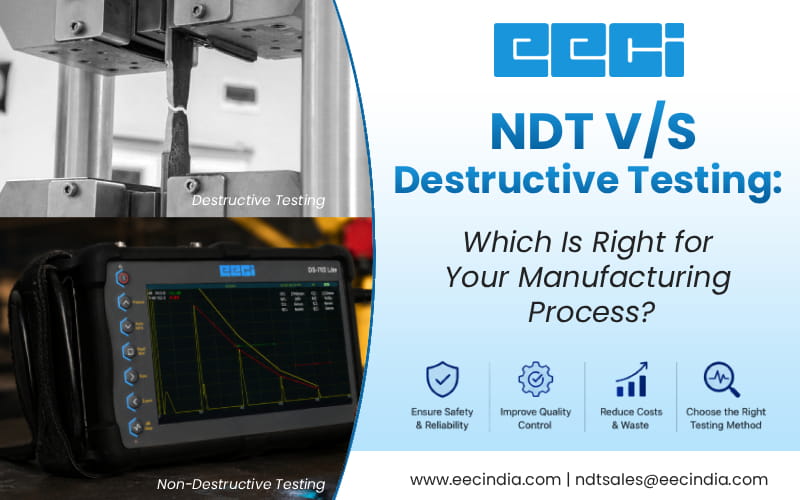
The two common techniques are (NDT) non destructive testing and destructive testing. Both help manufacturers understand the quality and behaviour of materials but they serve different purposes. Destructive testing process provides valuable information by testing material components until it deforms or fails while NDT components to be inspected for defects and variation without affecting their usability.
Now depending upon what you want to evaluate, the type of material and component involved, production requirements, and whether the component needs to remain in service after inspection, manufacturers can choose between NDT vs Destructive Testing Process.
What is Destructive Testing?
Destructive testing is a testing approach in which a material or component is deliberately subjected to controlled loads, forces or conditions until it deforms, cracks or fails. The purpose is to understand how the material behaves under stress and to determine important properties such as strength, toughness, ductility and fatigue resistance.
The component may be permanently damaged during the testing is generally performed on test specimens, samples or representative components rather than parts that are required for use. It is particularly useful during material qualification, product development and manufacturing process validation where understanding the actual performance limits of a material is important.
Type of Destructive Testing and their Application –
Depending on the material property or performance characteristic that needs to be evaluated the different destructive tests are selected.
- Corrosion Testing: This helps to examine how a material responds to corrosive environments and also assess its long-term resistance.
- Fatigue Testing: This helps to study how a material performs under repeated or cyclic loading and to determine its fatigue life.
- Tensile Testing: This helps to determine how a material behaves when subjected to a pulling force, including tensile strength, yield strength and elongation.
- Impact Testing: This evaluates material ability to absorb sudden impact energy and provides an indication of its toughness.
- Compression Testing: It measures the behaviour and strength of a material when subjected to compressive forces.
- Hardness Testing: It measures a materials resistance indentation or deformation. Hardness testing methods cause little or no damage to the component, that’s why it is also considered as minimally destructive or non-destructive depending upon the technique and application.
- Bend Testing: It evaluates ductility, flexibility and ability of material or joint to withstand bending without cracking.
What is Non-Destructive Testing?
Non-Destructive Testing is a set of techniques that is widely used to evaluate the properties, quality of materials, components or structures without causing any damage or wear & tear of any part keeping it in usable condition unlike destructive testing.
Non-destructive is commonly acknowledged as NDT in industries, technical sectors.
NDT inspection and testing play a crucial and vital role in wide sectors of industries like oil & gas. aerospace, manufacturing, constructions and power generation, nuclear power plants and many other sectors. It is trusted advanced technology which provides operations along with safety.
NDT is the best solution if one wants to detect defects, cracks, flaws, inconsistencies in any material without damaging or breaking it.
For different sectors of industries, NDT provides a versatile range of devices and NDT testing methods depending upon its application ensures the result which leads to the accuracy and desired output with minimal requirement NDT helps to prevent failures they occur and supports effective quality control in manufacturing.
For a deeper understanding of NDT principles, testing methods, industrial applications, and benefits, explore our complete guide to Non-Destructive Testing (NDT)
Types of Non-Destructive Testing Methods and Applications –
- Ultrasonic Testing (UT):
Ultrasonic testing uses high frequency sound waves to detect internal flaws or measure thickness.
Its work principle is based upon transmitting sound waves into the material.
Advantages- High accuracy, deep penetration, detecting internal defects
Application -Weld inspection, Thickness measurement, Crack detection.
- Radio Active Testing (RT):
Radio Active testing uses X-rays or Gamma rays to capture images of internal structures.
Its work principle is passing radiation through the material. A detector captures images showing defects.
Advantages – Permanent visual Record, detailed internal view
Application- Pipeline inspection, casting inspection, Aerospace components
- Magnetic Particle Testing (MPI):
Magnetic particle testing is used for detecting surface and near surface defects in ferromagnetic materials.
It works on the principle of applying magnetic field, gathers magnetic particles at defect location.
Advantages – Simple and quick, cost effective
Application – Crack detection in steel, weld inspection
- Liquid penetrating Testing (LPT):
Liquid Penetrant Testing detects surface defects using a liquid dye.
It works on the principle of applying liquid penetrant which seeps into the crack. The developer reveals cracks.
Advantages- Easy to use, works on non-porous material.
Application – Surface crack detection, aircraft component
- Eddy Current Testing (ECT):
Eddy current testing uses electromagnetic induction to detect flaws.
It works on the principle that electric current creates magnetic fields, and changes indicate defects.
Advantages- No contact required, fast inspection.
Application- Heat exchanger tubes, Aircraft inspection
- Visual Testing (VT):
Visual Testing is the simplest method involving direct observation.
It works on the principle of visually examining the surfaces with the help of the tools.
Advantages- cost effective, instant results
Application- Surface defects, Initial inspection
- Phased Array Ultrasonic Testing (PAUT):
It is an advanced version of ultrasonic testing using multiple probes.
Advantage- high precision
Application-Real time imaging
- Time of Flight Diffraction (TOFD):
It measures the time taken for diffracted sound waves.
Advantage: Accurate crack sizing
Application: Reliable result
Application- Pipeline inspection, casting inspection, Aerospace components.
Versatile Application Of NDT
NDT is widely used in various industries depending upon the requirement of its application. Let’s understand its area of application.
- Oil & Gas Industries: Pipeline inspection, leak detection, corrosion monitoring.
- Aerospace Industries: Aircraft component testing, structural integrity checks
- Manufacturing Industries: Defect detection, quality control
- Construction Industries: Building inspection, Structure
- Power Plants: Boiler inspection, Turbine Testing
Looking for the Right NDT Solution for Your Manufacturing Process?
Choosing the right inspection method depending on your requirements. Talk to EECI’s NDT experts to identify the right testing and inspection solution for your manufacturing process.
NDT vs Destructive Testing Process: What is the Difference?
The fundamental difference is the effect of the test component of the specimen. Destructive testing intentionally subjects the specimen to conditions that may permanently alter or damage it, while NDT is designed to obtain inspection information without compromising the components intended use.
| PARAMETER | DESTRUCTIVE METHOD | NON-DESTRUCTIVE METHOD |
| Effect on component usable | May permanently damage or destroy the component/specimen | Component generally remains usable |
| Primary objective | Determine mechanical/material performance | Detect defects and assess component condition |
| Testing frequency component | Usually sample-based | Can be perform on every |
| Application | Material qualification, validation, and R&D | Production process control and final inspection |
| Cost impact | May require replacement of tested specimens | Suitable for repeated inspection without destroying the component |
| Defect detection | Depends on test type | Can detect surface, near-surface, and internal discontinuities depending on the NDT method |
Conclusion
Choosing between NDT and destructive testing depends on the component material depends on the component material inspection, objective and production requirements. While destructive testing provides valuable insight into mechanical properties NDT enables manufacturers to assess component quality without affecting its usability.
EECI offers a wide range of NDT technology solutions including ultrasonic Testing, Eddy Current Testing, Magnetic Particle inspection, Radiography Testing, and Hardness Testing along with automated inspection systems for production environments.
These solutions help manufacturers achieve reliable defect detection, consistent quality and effective process control across different industrial applications.
